

Spiked ice cream has arrived, and its manufacturers are not afraid to place it within kids’ reach. Beyond the concern arising over creating adult versions of childhood desserts, PROOF Hard Ice Cream has been allowing freezer cases of the stuff to be situated alongside the check-out line at a major supermarket in the Bay Area. The placement raises questions of kid-friendly and kid-accessible products, inappropriate business practices, and corporate contempt for the norms that are meant to promote safer alcohol sales.
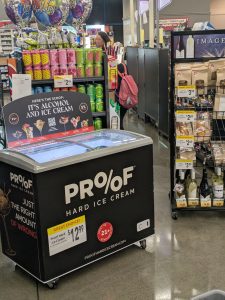 PROOF is just one of several spiked ice cream brands that have made it to market over the past few years. Each package of PROOF has a full standard serving of alcohol, and at 12 oz. per disposable container, they are clearly packaged for immediate consumption. On its web page, the company boasts of its focus on e-commerce, meaning sales directly to consumers over the internet. By dropping packages directly on doorsteps, PROOF can bypass regulators, oversight, and responsible sales practice—not to mention carding. Both web sales and high-traffic checkout-adjacent placement promote impulse buys, as does most U.S. consumers’ surface reactions to ice cream in single-serving containers.
Below the surface, though, this push to conflate kid-friendly treats and an adult dose of alcohol speaks to two contrasting motivations within the industry. The first of these—a perennial one, and one that’s shared by the alcohol, tobacco, cannabis, and other recreational drug industries—is the need to attract the youngest possible consumers without being caught doing so. Youth-friendly products are not an accident, but rather a fundamental business driver. The younger someone starts drinking, the more likely they are to develop chaotic drinking patterns in adulthood. The heaviest drinkers then fuel the majority of profits. The rule of thumb, according Philip Cook’s book Paying the Tab, is that the heaviest 10% of drinkers consume 60% of all alcohol sold. Without the susceptibility to alcohol use disorder driven by early adoption of drinking habits, over half of the industry risks drying up.
The second motivation for the rise of PROOF and other seemingly family-friendly “boozified” products has emerged this decade. After over 20 years of rampant deregulation and capture of the legislative and regulatory systems throughout the country, the alcohol industry faces shrinking profits and dwindling customers. As the Zoomers enter young adulthood, the generation seems leery of the endless creep of booze into every facet of daily life. The expansion of alcoholic products that mask any taste of alcohol—from alcopops to hard seltzers to cocktails-in-a-can—speak to the industry’s efforts to convince young customers that they can consume alcohol without having to consume alcohol.
Regardless of why PROOF and its ilk are suddenly in checkout lines, its marketing strategy has the same effect as many prior industry pushes of introductory products. Hard ice cream trains youth to treat alcohol as an impulse buy like candy. It parades an alluring product in front of kids which would sensitize them to alcohol’s effects. And it keeps degrading the understanding of alcohol as a regulated product adults consume with intentionality, moderation, and care.
READ MORE about the impact of alcopops and ways to fight back.
READ MORE about the explosion of crossover products.
Published on: December 23, 2025